


Sharp perspectives on the issues shaping Southeast Asia
By TENGKU NOOR SHAMSIAH TENGKU ABDULLAH
March 10, 20266ASEAN at the Crossroads: Can the Bloc Still Hold?
From the South China Sea to Myanmar’s unresolved civil war and a simmering border conflict between two of its own members, ASEAN enters 2026 carrying the weight of unfinished business. The question is no longer whether the bloc faces a crisis of credibility — it does. The question is whether its leaders have the will to do something about it.
When Malaysia handed the ASEAN chairmanship to the Philippines at the 47th ASEAN Summit in Kuala Lumpur last October, the ceremony carried more than symbolic weight. It was a moment that illustrated, almost perfectly, the paradox ASEAN now inhabits: a region of enormous economic promise, convening power, and strategic relevance and yet one struggling to govern itself.
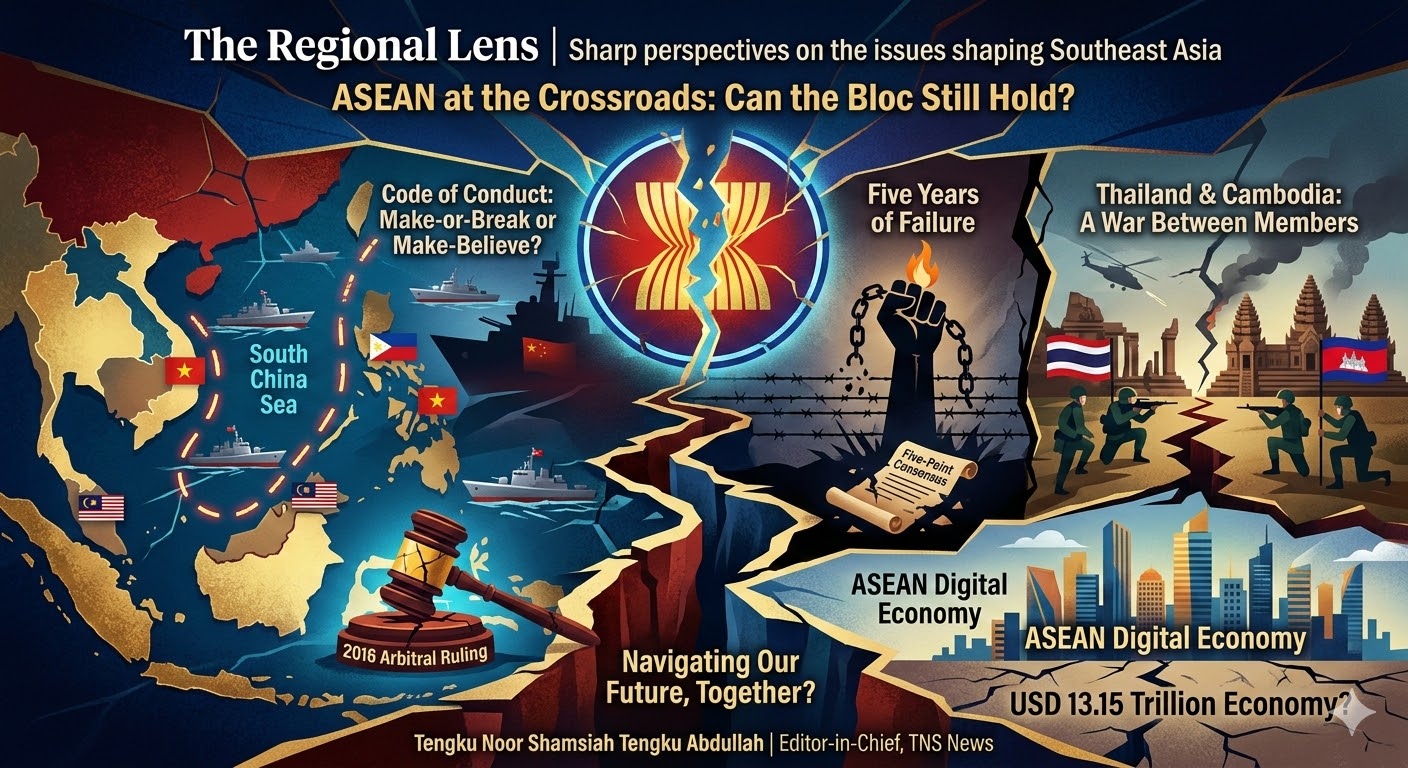
The Philippines assumed the chair on January 1 under the theme “Navigating Our Future, Together.” President Ferdinand Marcos Jr. has set an ambitious agenda: maritime security, a breakthrough on the long-delayed South China Sea Code of Conduct, digital economy integration, and people empowerment. On paper, it reads well. In practice, Manila inherits a house that is anything but in order.
“The question is no longer whether ASEAN faces a crisis of credibility. It does. The question is whether its leaders have the will to do something about it.”
The Code of Conduct: Make-or-Break or Make-Believe?
The centrepiece of the Philippine chairmanship is the push to finalise a legally binding Code of Conduct (COC) for the South China Sea a goal that has been on ASEAN’s agenda since 2002, with formal negotiations only beginning in 2018. The agreed deadline is July 2026.
Philippine Foreign Secretary Ma. Theresa Lazaro has pushed for monthly working group meetings to accelerate the pace, describing the commitment of both ASEAN and China as being “heavily invested” in concluding the agreement. There are even tentative signals from Beijing: China’s ambassador to Manila, Jing Quan, has been reported by Philippine Senate Committee on Foreign Relations Chairman Erwin Tulfo as expressing enthusiasm for the COC’s conclusion.
But scepticism runs deep. Wu Shicun, founding president of China’s National Institute for South China Sea Studies, has been blunt, stating that a concluded Code is “100 per cent not likely” under the Philippines’ watch primarily because Manila will inevitably raise the landmark 2016 arbitrarily ruling by the Hague tribunal, which rejected Beijing’s sweeping claims over most of the South China Sea. China has never accepted that ruling.
The fundamental disagreements have not gone away: whether the COC should be legally binding; whether it should exclude joint military drills with powers outside the region; and whether oil and gas exploration should be restricted to ASEAN partners alone. These are not technicalities. They are existential questions about sovereignty that no amount of monthly meetings can paper over.
What is at stake goes beyond the Philippines. Five ASEAN members – Brunei, Indonesia, Malaysia, the Philippines, and Vietnam have overlapping claims with China’s nine-dash line. The South China Sea carries an estimated USD 5.3 trillion in commercial shipping annually. If ASEAN cannot produce even a framework for managing conduct in these waters, its credibility as a security architecture collapses.
Myanmar: Five Years of Failure
March 2026 marks five years since Myanmar’s military seized power in a coup, removing the elected government of Aung San Suu Kyi. In that time, ASEAN has produced one major response: the Five-Point Consensus of April 2021, calling for dialogue, an end to violence, and the appointment of a special envoy. All five points remain largely unimplemented.
The junta pressed ahead with elections in late 2025, which ASEAN as a bloc refused to recognise as legitimate. Yet even here, the bloc’s unity frayed. While Malaysia, Singapore, and Indonesia withheld recognition, Cambodia and Vietnam sent observer delegations to the polls. Thailand, which bears the heaviest burden of cross-border displacement and illicit trade, has pushed openly for ASEAN to re-engage with the junta, and has offered to mediate between the bloc and Naypyidaw.
Philippine Foreign Secretary Lazaro has been appointed Special Envoy of the ASEAN Chair on Myanmar for 2026. It is an important signal of intent. But analysts are measured in their expectations. As Cambodian political scientist Kin Phea observed at the ASEAN Foreign Ministers’ Retreat in Cebu in January, the Myanmar crisis is rooted in internal history, ethnic divisions, and political structure that no external pressure can resolve. “Myanmar must put national interest and peace first,” he said. “It is not certain that the crisis can be solved through the ASEAN framework alone.”
“ASEAN’s Five-Point Consensus has become a ritual reference point. Few now doubt it has failed but member states remain reluctant to agree on what might replace it.”
Thailand and Cambodia: A War Between Members
Perhaps the most uncomfortable crisis facing the Philippine chair is one that ASEAN rarely confronts: an armed conflict between two of its own members. Fighting between Thailand and Cambodia along their 817- kilometer land border erupted in July 2025, escalating to the point where Thailand deployed F-16 fighter jets in airstrikes against Cambodian military positions, the first combat operations by the Royal Thai Air Force since the Thai-Laotian border war of 1987–88. More than 200,000 civilians were displaced on both sides.
A ceasefire the Kuala Lumpur Peace Accord was brokered by then-ASEAN Chair Malaysia and signed at the 47th ASEAN Summit in October 2025. Further fighting broke out in December before a second ceasefire on December 27. As of March 2026, that ceasefire holds, though sporadic incidents and deep mutual mistrust persist along the border.
The dispute is rooted in colonial-era boundary ambiguities dating to 1904 and 1907 French treaties, and has long centred on contested highland territories along the Dangrek Mountains. The conflict has inflamed public opinion in both nations and exposed a troubling reality: ASEAN’s non-interference principle was never designed to manage interstate armed conflict between its own members. The bloc has no enforcement mechanism, no standing security force, and no clear mandate to compel de-escalation when dialogue fails.
The Deeper Question: Is the ASEAN Way Still Fit for Purpose?
ASEAN was founded in 1967 on a bedrock principle: that member states do not interfere in each other’s internal affairs. That principle held the bloc together through the Cold War, through the Asian financial crisis, through the turbulence of post-colonial nation-building. But the world of 2026 is testing its limits severely.
The bloc now has 11 members following Timor-Leste’s historic accession at the Kuala Lumpur Summit in October 2025. Its collective GDP stands at approximately USD 13.15 trillion in purchasing power parity terms. It sits at the intersection of the US-China strategic rivalry, absorbs massive flows of foreign direct investment in AI infrastructure and data centres, and is positioning itself as the world’s potential fourth-largest economic bloc.
And yet: a civil war in one member state has ground on for five years without resolution. Two member states exchanged airstrikes in 2025. The region’s most consequential maritime security agreement remains unsigned after more than two decades of negotiation. Domestic political turbulence in Thailand, the Philippines, and Indonesia is pushing leaders inward precisely when regional leadership is most needed.
The Asian Development Bank projects ASEAN+3 economic growth at 4.0 percent in 2026, down from 4.3 percent in 2025, with the external environment described as “highly uncertain.” US tariffs on ASEAN economies have ranged from 10 to 48 percent. Against this backdrop, the bloc’s capacity to act collectively on anything security, digital integration, trade is being compressed from both inside and outside.
“ASEAN’s convening power remains real. But convening is not the same as deciding. And deciding is not the same as acting.”
What Manila Must Do
The Philippines’ chairmanship should not be written off. Manila has signalled genuine ambition on the South China Sea, and the ASEAN Digital Economy Framework Agreement (DEFA) described as a potential game-changer for the region’s USD 2 trillion digital market ambition is expected to be signed this year. These are meaningful deliverables.
But President Marcos must resist the temptation to use the chair primarily as a platform for the Philippines’ own bilateral disputes with Beijing. The chair’s role is consensus-builder, not litigant. The most lasting contribution Manila can make is to begin an honest conversation within ASEAN about updating the bloc’s conflict management framework not replacing the non-interference principle, but qualifying it with practical mechanisms for when interstate violence or mass atrocities make pure non-interference untenable.
ASEAN’s greatest strength has always been that it exists at all that eleven diverse nations, with different political systems, colonial histories, and strategic interests, chose to build a common table. That achievement is not trivial. But a table without rules, without enforcement, and without the will to call out violations is, in the end, just furniture. 2026 will test whether ASEAN is still architecture or merely décor.
- TNS NEWS
Tengku Noor Shamsiah Tengku Abdullah is Editor-in-Chief of TNS News and a senior media professional with more than three decades of experience in Malaysian and regional journalism, spanning print (The Star), national broadcasting (RTM), and wire and television services (Bernama).
Her weekly column The Regional Lens offers sharp perspectives on the political, economic and strategic developments shaping Southeast Asia.
Follow the power. Connect the dots. Understand Southeast Asia.