


By Tengku Noor Shamsiah Tengku Abdullah

PUTRAJAYA, Dec 30 – “When I was Prime Minister for the second time, I was very weak. And even my own members at times did not support me,” said the former premier Tun Dr Mahathir Mohamad.
Mahathir’s recounting revealed vulnerability and deep disappointment stemming from the defection of his own supporters during his second term as Prime Minister, highlighting a sense of personal betrayal.
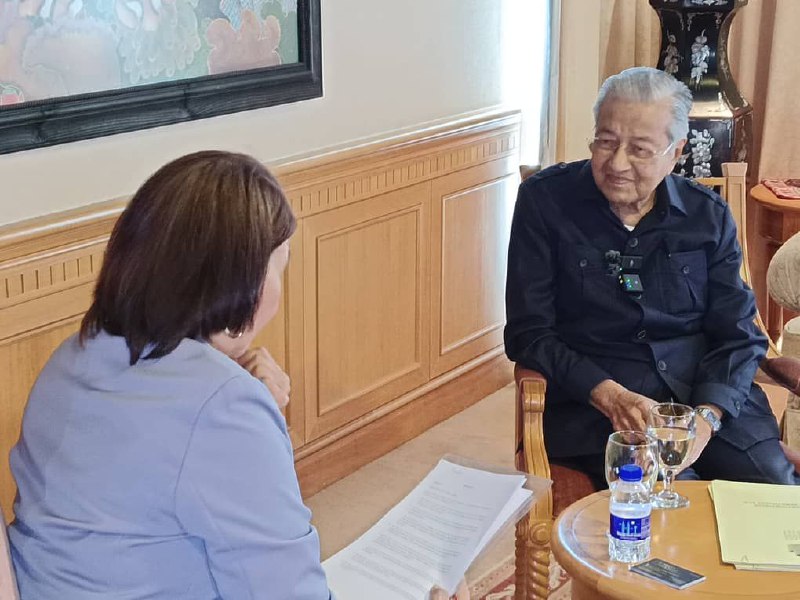
In an Exclusive Interview, Former Malaysian Prime Minister Mahathir Mohamad, reflecting on his extensive tenure, revealed the stark contrasts between his leadership eras, detailing moments of triumph and challenge that marked his governance from 1981 to 2003 and his later term from 2018 to 2020.
During his tenure from 1981 to 2003, Mahathir acknowledged a considerably stronger position with a resounding 2/3 parliamentary majority. This empowered him to drive substantial changes and reforms, backed by robust governmental support.
“When I first became Prime Minister, I had two-thirds majority in Parliament backing me, “he said adding that with this overwhelming support, he had the power to amend the constitution if needed.
“According to the constitution of the country, if you have two-thirds majority, you can actually change the constitution. So the first time I was Prime Minister, I was very strong.”
“But the second time I didn’t have the two-thirds majority. I had a majority but not sufficient for me to act strongly in the government,’’ he told TNS News in an interview Wednesday in his office at Perdana Leadership Foundation, Putrajaya.
Mahathir who served as the fourth and seventh Prime Minister said:“So as it happened, my own supporters changed their stand. They decided that they should leave the party. They leave the government and join with the opposition.”

Mahathir’s second term: A tale of betrayal and disappointment
In contrast, his later term, spanning from 2018 to 2020, grappled with significant challenges as coalition members withdrew support, aligning themselves with the opposition, thus leaving him in a weakened state.
The turning point came in May 2018 when Pakatan Harapan (PH) secured victory in the 14th General Election, obtaining a simple majority in Parliament to form the federal government. Reflecting on the post-2018 political landscape, Mahathir detailed, ‘Following the 2018 election, the opposition emerged victorious. However, it wasn’t a Malay-dominated opposition; it was multiracial, with other ethnicities having more influence.’
So when we had that situation, Mahathir said former Prime Minister Datuk Seri Najib Razak at that time started talking about a Malay Muslim government.
“As we are not a Malay Muslim government, this affected the Malays who were supporting the government from my own party. They felt uncomfortable because they had defeated a Malay government and set a non-Malay government.
So because of that, they thought that they should join up with the defeated UMNO and PAS to form a Malay Muslim government. So when they leave the government party, the government party collapsed,” explained Mahathir who was Bersatu Chairman at that time.
From Poverty to Progress, Unveiling Malaysia’s Transformation Journey
Addressing him as an architect for Malaysia’s modernisation and industrialisation, Mahathir was asked on his policies and initiatives that he implemented during his tenure as PM in transforming the economy and society.
Upon gaining independence, poverty was rampant, and a significant portion of the population had no income. In response, Mahathir said: “we initiated the FELDA Scheme, opening up land to alleviate this hardship.’’
‘’We allocated land to those without income, yet the available land proved insufficient, leaving many still without income. To generate livelihoods, we opted to venture into the industrial sector.
Industry can employ up to 500 people per acre, unlike agriculture, where one acre can barely sustain one person. This shift from agriculture to industry was essential for job creation.
Delving into economic policies, Tun Dr. Mahathir remarked on the 30% Bumiputera wealth target, clarifying, that 30 percent was not fixed by him. It was already set by the previous government under Former Prime Minister Tun Abdul Razak.”
It was decided that despite the Malays comprising nearly 70% of Malaysia’s population, only 30% of the country’s wealth would be allocated to them.
Role and Limitations of a Small Country in Global Politics
In his earlier years in office, Mahathir became well-known for his outspokenness on contentious matters, engaging with regional and global issues including ASEAN integration, the Israel-Palestinian conflict, and US-Chinese relations. When discussing his foreign policy principles, he emphasized the importance of commenting on injustices while maintaining sensitivity to the situations in those countries.
“Well, if we see some injustice is done to people, we feel we have a right to make a comment. But of course, we have to be sensitive also to the situation in those countries.
“We can only make some comments only, but we cannot take any action because we were a very weak country, a very small country. We can’t do anything. We can only talk. And that’s all.“
Assessing Leadership and Governance: Insights on Malaysia’s Development and Anti-Corruption Efforts
The interview delved into Mahathir’s relationship with Datuk Seri Anwar Ibrahim, both his former deputy and the current Prime Minister.
Addressing the longstanding and intricate nature of this association, Mahathir reflected on Anwar’s role as his deputy and potential successor.
During the interview, Mahathir openly acknowledged that he had granted Anwar the opportunity to act as Prime Minister during his three-month leave.
However, he concluded that Anwar lacked the essential skills for effective leadership, making it challenging for Tun Dr. Mahathir to accept him as a capable leader.
Reflecting on Anwar’s present tenure, Tun Dr. Mahathir voiced discontent, remarking, “After a year in office, I see little progress apart from promises of monetary aid.”
He highlighted that the focus seemed primarily on monetary distributions, leaving many citizens still struggling with poverty and unemployment, lacking even the means to afford food.
Mahathir pondered over the current PM’s governance, expressing worry: “Initially, I waited for three months to assess. It’s clear he hasn’t addressed the country’s economic and financial issues.”
Mahathir scrutinized the government’s stance on corruption, citing its selective pursuit in anti-corruption endeavors. “Corruption persists, but under (Former PM) Najib’s tenure, it ballooned,” he emphasized, highlighting disparities in handling cases like Ahmad Zahid Hamidi’s 47 corruption charges versus Syed Saddiq Abdul Rahman’s conviction for criminal breach and money laundering.
He questioned the government’s priorities, notably in cases like Tun Daim Zainuddin’s property seizure, querying why the focus wasn’t extended to others’ financial sources.
Mahathir lambasted the government for its biased anti-corruption campaign, questioning its sincerity and fairness. He highlighted the unequal scrutiny of specific individuals, expressing concern that others with significant wealth weren’t facing similar inquiries into their financial sources.
Advocates Responsible Voting and Dismisses Legacy Worries, Urging Malaysians to Choose Wisely
Mahathir emphasized the need for wise voting, drawing from his four decades of experience as a prominent and controversial leader in Malaysian politics. He warned against the dangers of voting based on monetary rewards, arguing that such behavior could result in poor governance, economic losses, and a bleak future for Malaysia.
“The fate of Malaysia lies in the hands of the people. If they (Malaysians) vote for money, they will end up with a bad government and lose their money and their country,” he said.
His advice to Malaysians on selecting leaders was: “My advice (to the voters) is to choose good people, not to be corrupted by money. When you are corrupted by money, you can be sure that the people who corrupt you are not good people.”
He also discussed the concept of a unity government and its structure. He explained that a unity government is a government that includes the opposition.
He gave an example, saying, in Britain during the war, the Conservative Party won the election, but the Conservative Party decided to work with the Labour Party.
“That is a unity government. This is not a unity government. This is a government of people who support the government only. People who do not support the government in the opposition are not in the government.
Therefore, it is not a unity government.” When asked about how he evaluated his legacy, Mahathir said that it was up to others to judge his impact. He expressed his philosophy on legacies, saying that he always focused on action rather than worrying about how his legacy would be seen.
“I don’t evaluate my legacy. It is for other people to evaluate. I actually, I don’t worry about legacies. I just do things and if people appreciate them, they appreciate them. If they don’t like them, they don’t like them. That is something I cannot decide,” he said.
Responding to Abdulhakim Idris, Uyghur Activist’s Open Letter, Urges Realism and Compromise
On the international front, Mahathir who recently made a call to the Malaysian government and organisations not to support Uyghur Advocacy work in Malaysia was asked to justify his stand on the matter.
Following his call, the Centre for Uyghur Studies (CUS) Executive Director Abdulhakim Idris wrote an open letter to Mahathir seeking the former leader to retract his statement.
Responding to the open letter from CUS, Mahathir highlighted the complexities, stating, “There are things that we can do, and there are things that we cannot do. We have to accept that Singapore, for example, although it was a part of Malaysia, today it is a different country. We accept that there are four Malaysian states now ruled by Thailand and we are not fighting to get it back.”
Emphasizing the pragmatism in international relations, he asserted, “We do what we can do but we cannot fight against China. China is a very big trading partner and we want to continue trading with them.”
Mahathir underscored the challenge of Uyghur independence, noting, “They have to find a way of accepting that they cannot become independent anymore because that means fighting against China.”
Drawing parallels with the situation in Taiwan. He expressed skepticism about the effectiveness of fighting against China for independence,
He highlighted Taiwan’s unique situation, “Of course Taiwan is a part of China. You can’t deny that. But it has a different government. And they don’t want to be a part of China.”
He pondered the complexities of the Taiwan-China relationship, acknowledging the strategic interdependence despite political differences, “So the relationship is strange because it is a part of China. Yet it cannot be ruled by China.”
He concluded by cautioning against war, emphasizing the potential harm,
Mahathir said “What they’re capable of doing, naturally, is engaging in a conflict that could result in widespread casualties and extensive destruction.”
It seems unlikely that the Chinese would want to harm Taiwan, especially considering Taiwan’s investments in China,” he said.
The trade between the two indicates a mutual interest that suggests otherwise, as Mahathir mentioned.”
On the request by Abdulhakim in the open letter for Mahathir to retract and apologise to the Uyghur community, the former leader said: “Well, I can retract the statement. I can apologize, but the situation will not change.”
Further elaborating on his stance regarding Uyghur affairs, Mahathir emphasized the geopolitical reality, explaining, “The Uyghur region is currently part of China. “
He pointed, engaging in conflict with China would incur significant costs and damage.
Mahathir emphasized, “Occasionally, we must embrace being governed by others because achieving independence comes with a price that’s too high to bear.”
Mahathir Condemns World Uyghur Congress Stance on Hamas
Separately, Mahathir criticized the World Uyghur Congress (WUC) for condemning Hamas regarding attacks on Israel.
In a statement earlier, WUC expressed strong condemnation for Hamas’ attacks on Israeli civilians, expressing deep concern over the escalation of conflict and loss of lives.
Noting the irony, comparing the situation of the Palestinians and the Uyghurs, Mahathir said: “We cannot understand that because the Hamas was formed after Israel was created. Israel, part of Palestine, was taken to make the state of Israel.
And since then, Israel has been killing Palestinians, jailing thousands of Palestinians without trial and building settlements on Palestinian lands. They have been doing all these things, oppressing the Palestinians.
And of course, the Palestinians, they want their land back and they decided to fight. But when they decided to fight, the Israelis said this is wrong, they shouldn’t fight.
Reflecting on the challenges and blessings of growing old
Mahathir concluded the interview on a reflective note, expressing thoughts on aging and health, saying, “When you become old, you cannot think anymore. You have to accept that.”
Sharing insights on maintaining well-being, the charismatic former leader said, “If we are lucky, we don’t suffer from diseases like cancer and all that. Then you can have a good life.”
Discussing the advancements in medical care, he acknowledged, “Today, heart problems, you can do something. You can have an operation, you can have some medicine to help you and all that.”
However, he underscored the challenges posed by certain health conditions, noting, “But if you get cancer, certain cancers can be treated, certain cannot be treated. So if you have cancer, your health cannot be very good.”
Conclusion
In this article, Mahathir, Malaysia’s longest-serving and most influential leader, shared his candid and honest reflections on his political journey, achievements, challenges, and regrets. He revealed the stark contrasts between his first and second terms as Prime Minister, highlighting the moments of strength and weakness, triumph and disappointment that marked his governance.
He also discussed his economic policies, foreign policy principles, legacy, and stance on various issues, such as the Uyghur situation, the Palestinian cause, and the current government’s performance.
He emphasized the importance of wise voting and realistic compromise in international relations, and urged Malaysians to choose good leaders who are not corrupted by money.
He concluded by saying that he does not worry about his legacy, as it is up to others to evaluate his impact.
– TNS News