


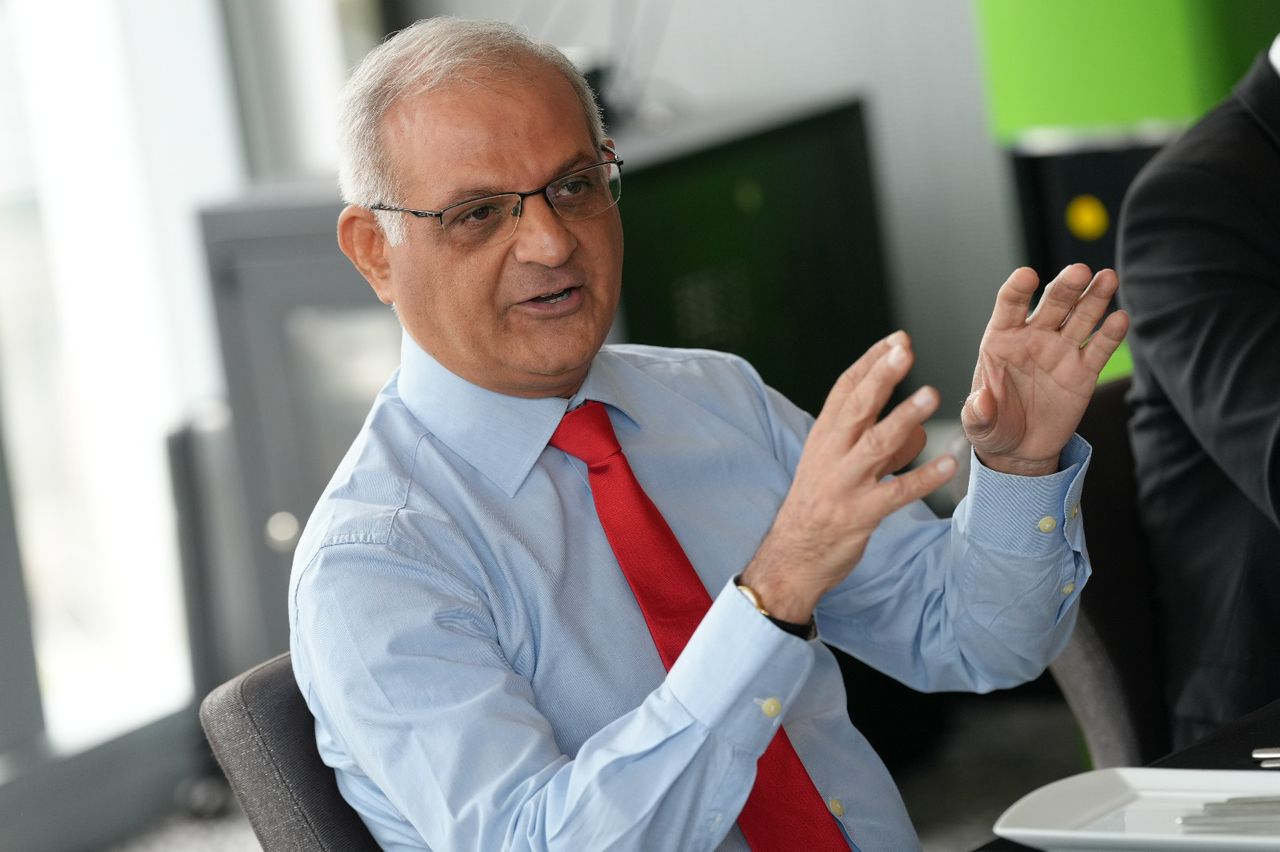
With the Global Macro Risk Index pointing to a Stress Regime and oil sitting above US$100 per barrel, Juwai IQI Global Chief Economist Shan Saeed argues that the risks of 2026 are not hidden — they are visible, measurable, and continuously repriced. The challenge, he says, is not awareness. It is interpretation.
BY TENGKU NOOR SHAMSIAH TENGKU ABDULLAH
KUALA LUMPUR, Apr 8 – The world is not on the edge of another 2008. But it is not in calm waters either. For Shan Saeed, Global Chief Economist at Juwai IQI, the macro environment of 2026 demands a different kind of reading — one that moves beyond traditional indicators into what he calls a “strategic navigation system” for an era of persistent, structural risk.
In an interview with TNS News, Shan laid out the architecture of the Global Macro Risk Index, or GMRI — a composite framework he has developed to quantify systemic risk across five transmission channels: energy markets, financial conditions, geopolitics, inflation dynamics, and global liquidity.
“GMRI transforms uncertainty into signal — enabling decision-makers to anticipate, not react to, macro dislocations.”
The Ghost of 2008
Shan’s starting point is the crisis that reset the world’s understanding of systemic risk. In 2008, the breakdown was total and simultaneous — across institutions, markets, and liquidity channels. Oil surged to US$147 per barrel, amplifying inflationary pressures even as interbank markets froze. Bear Stearns collapsed in March. Lehman Brothers triggered a global credit seizure in September. AIG required emergency government support. Merrill Lynch, once valued at roughly US$300 billion, was acquired by Bank of America for a fraction of that sum.
The policy response was equally unprecedented — near-zero interest rates,
quantitative easing deployed by the US Federal Reserve, the European Central Bank, the Bank of England, and the Bank of Japan, and the US$700 billion Troubled Asset Relief Program to stabilise the system.
For Shan, the structural lesson endures: “Systemic risk is never absent — it is simply mispriced until it materialises.”
2026: Fragility, Not Collapse
The 2026 macro landscape is more complex — but also more legible. Brent crude is trading at US$105–115 per barrel. US gasoline sits at US$4.00–4.10 per gallon. Core inflation remains sticky at 2.8–3.2 per cent globally. US 10-year yields are at 4.2–4.4 per cent. Global debt has surpassed US$310 trillion.
Financial conditions are tightening structurally. Rising real yields are compressing valuations. Gold is experiencing volatility-driven margin cycles. Bond market liquidity remains structurally thinner than it was before 2008.
“This is not a crisis of collapse,” Shan said. “It is a regime of priced fragility and persistent macro tension.”
His GMRI score for 2026 reflects this precisely: 62–68, placing the global economy squarely in what the index classifies as a Stress Regime — the zone where, as he puts it, markets shift from pricing growth to pricing risk.
GMRI SCORING SCALE
0–30 Stable regime
31–60 Elevated risk
61–80 Stress regime ◀ 2026 estimate: 62–68
81–100 Systemic crisis
Energy at the Epicentre
Of all the transmission channels GMRI monitors, Shan singles out energy as the most consequential.
“Oil is no longer just a commodity — it is a system-defining macro asset,” he told TNS News, noting its role in shaping inflation expectations, central bank reaction
functions, external balances, currency stability, and sovereign risk premia.
The numbers are striking in their reach. Energy contributes between 7 and 10 per cent to the consumer price index directly, rising to 15–25 per cent when indirect effects are included. A US$10 increase in oil prices adds 0.2–0.4 percentage points to global inflation. For emerging markets, oil above US$100 per barrel widens current account deficits by 1–3 per cent of GDP.
At the centre of this sits the Strait of Hormuz — through which roughly 20 million barrels per day transit, representing approximately 20 per cent of global supply and 25–30 per cent of seaborne crude flows.
“This is not geography — it is global macro infrastructure,” Shan said. Any disruption there, he warned, cascades immediately: freight rates rise 30–70 per cent, insurance premiums can double, and both direct and second-round inflation effects feed through rapidly into fiscal strain and subsidy expansion.
“Energy shocks are no longer cyclical — they are systemic catalysts.”
Capital Flows in a Multipolar World
Shan also addressed the evolving architecture of global capital flows — a shift he describes with deliberate precision.
“The global monetary system is evolving — not collapsing,” he said. The expansion of yuan-denominated trade, in his reading, reflects incremental diversification rather than displacement of the dollar. China accounts for roughly 15–16 per cent of global crude imports, and yuan-based settlement is expanding across bilateral corridors.
“This is not de-dollarisation. It is the emergence of a parallel settlement architecture.”
Capital flows, he argued, are now multipolar, geopolitically influenced, and strategically allocated — no longer passively recycled through a single dominant channel.
From Indicator to Decision System
The five core components of GMRI — the Energy Shock Index, the Liquidity and
Financial Conditions Index, the Geopolitical Risk Matrix, the Inflation Persistence Gauge, and the Capital Flow and Currency Realignment Index — are designed to work together as a decision-making system, not a passive scoreboard.
At 62–68, 2026 sits at the lower end of the stress band — but firmly within it. This, Shan argues, marks a structural pivot from the post-2008 decade of liquidity expansion.
“From beta-driven rallies to alpha-driven selectivity. From synchronised markets to fragmented outcomes. From cheap liquidity to disciplined capital allocation.”
Positioning Ahead of the Shift
For investors, Shan’s prescription is direct: increase exposure to energy and real assets, actively manage duration risk, prioritise liquidity resilience, and diversify across currencies and geopolitical blocs.
For policymakers, the imperatives are equally clear — preserve policy credibility, shift toward targeted subsidies, strengthen reserve buffers, and anticipate second-round inflation effects.
“Mispricing risk today is no longer cyclical — it is systemic and unforgiving,” Shan warned.
His closing argument is the sharpest distillation of the GMRI philosophy: unlike 2008, today’s risks are not hidden. They are visible, measurable, and continuously repriced. The challenge is not awareness — it is interpretation, and decisive positioning.
“GMRI ensures you see it before it sees you,” he said. “Leadership is not about reacting to change — it is about commanding it.”
– TNS NEWS
ABOUT SHAN SAEED
Shan Saeed is Global Chief Economist at Juwai IQI, a leading property, technology, and investment group operating across Kuala Lumpur, Singapore, Hong Kong, London, Melbourne, Dubai, Toronto, and beyond. He brings over two decades of financial market experience across private banking, risk and compliance management, commodity research, and global macroeconomic strategy. Shan holds an MBA from the Booth School of Business at the University of Chicago and a first MBA from IBA Pakistan, earned in collaboration with the Wharton School, University of Pennsylvania. He is also trained in Alternative Banking Strategies from Harvard Business School. Based in Kuala Lumpur, he is a widely cited financial market commentator whose views regularly appear in international media.
One thought on “TNS NEWS | ECONOMICS & MARKETS See the Risk Before It Sees You: Shan Saeed on the Global Macro Stress Regime of 2026”