


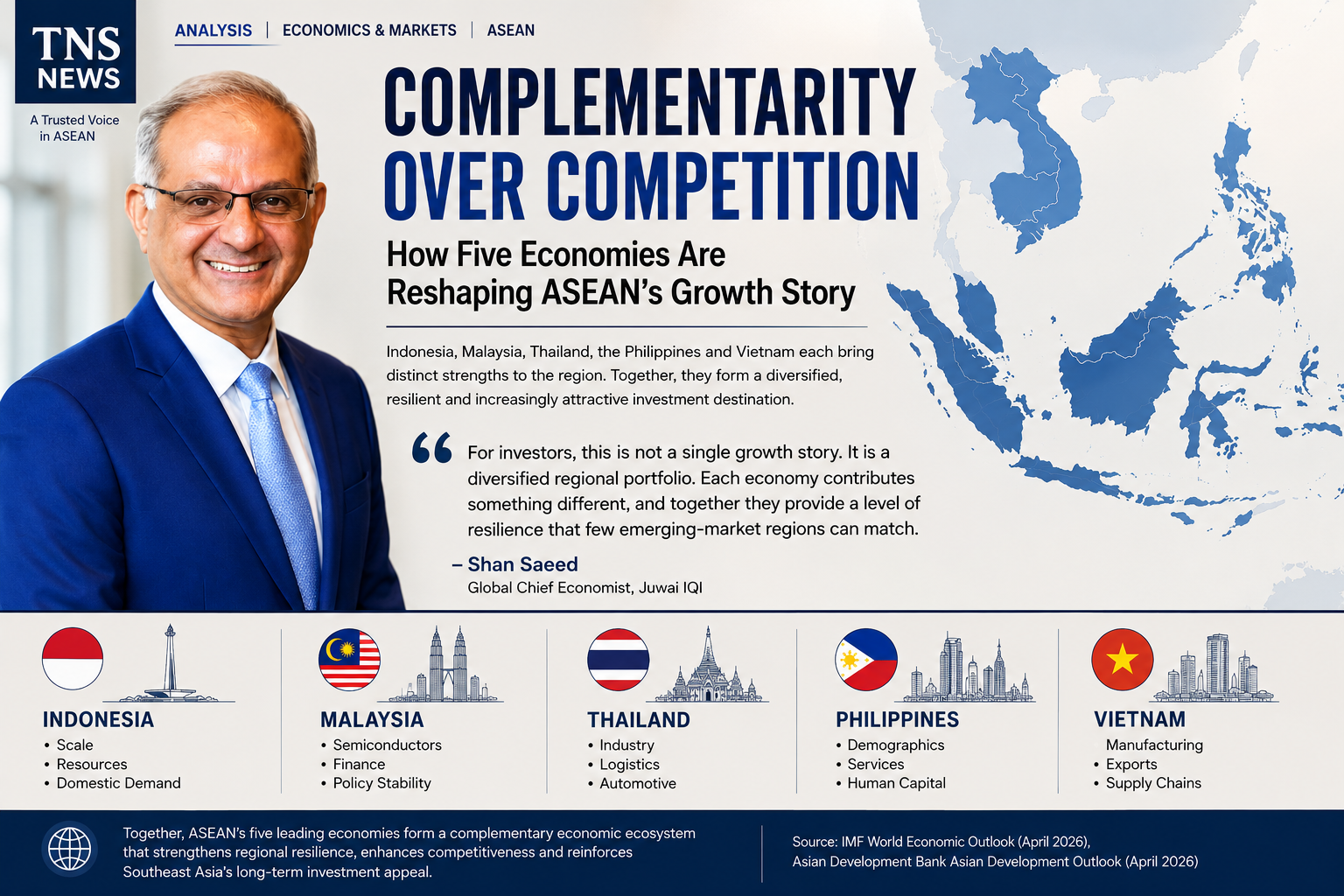
Indonesia, Malaysia, Thailand, the Philippines and Vietnam are increasingly shaping ASEAN’s long-term economic trajectory. According to Juwai IQI Global Chief Economist Shan Saeed, their greatest strength lies not in competing with one another, but in the complementary roles they play across manufacturing, finance, technology, resources and services.
By TENGKU NOOR SHAMSIAH TENGKU ABDULLAH
KUALA LUMPUR, July 10 – ASEAN’s next phase of economic growth is unlikely to be driven by a single dominant economy. Instead, it will increasingly depend on how its five largest and most strategically important markets complement one another to strengthen the region’s competitiveness in an increasingly fragmented global economy.
That is the assessment of Juwai IQI Global Chief Economist Shan Saeed, who describes Indonesia, Malaysia, Thailand, the Philippines and Vietnam as ASEAN’s “Fabulous Five” a grouping whose combined demographic scale, industrial diversity and economic resilience are reshaping the region’s investment narrative.
Rather than competing for the same opportunities, the five economies are developing distinctive strengths that collectively position ASEAN as one of the world’s most attractive destinations for long-term capital.
“Their combined demographic scale, economic diversity and institutional depth are what make ASEAN a genuinely systemic investment story rather than simply a collection of individual growth markets,” Shan told TNS News.
Together, the five economies account for more than 611 million people — representing nearly 90 per cent of ASEAN’s population — and generate a combined economic output exceeding US$4.5 trillion. They also account for the majority of the region’s foreign direct investment inflows, infrastructure spending and manufacturing capacity, making them central to Southeast Asia’s long-term economic outlook.
As multinational corporations continue to diversify supply chains, governments invest heavily in strategic industries and global investors seek greater resilience amid geopolitical uncertainty, ASEAN’s competitive advantage is becoming increasingly collective rather than individual.
Growth Profiles Reflect Different Stages of Development
While headline GDP growth rates often dominate economic discussions, Shan argues that focusing solely on which country is expanding fastest overlooks the broader structural transformation taking place across the region.
According to the International Monetary Fund’s April 2026 World Economic Outlook, Vietnam is projected to record real GDP growth of 7.1 per cent this year, followed by Indonesia at 5.0 per cent, Malaysia at 4.7 per cent, the Philippines at 4.1 per cent and Thailand at 1.5 per cent. Meanwhile, the Asian Development Bank expects developing Southeast Asia as a whole to expand by 4.7 per cent in 2026, supported primarily by resilient domestic demand.
Rather than viewing these differences as signs of uneven performance, Shan believes they reflect varying stages of economic maturity and structural evolution.
“This divergence is not a structural weakness,” he said. “It reflects different stages of demographic transition, industrial upgrading, policy implementation and economic maturity. Sophisticated investors increasingly assess not only the speed of growth, but also its composition, quality and sustainability.”
In other words, ASEAN’s strength lies less in uniformity than in diversity.
Five Economies, Five Distinct Competitive Advantages
Indonesia remains the region’s demographic and resource powerhouse. Supported by one of the world’s largest domestic consumer markets, abundant natural resources and continued downstream industrialisation, Southeast Asia’s largest economy continues to provide a strong foundation for regional growth.
Indonesia’s economy expanded by 5.61 per cent year-on-year in the first quarter of 2026, surpassing market expectations as household consumption, government expenditure and investment all strengthened.
“Indonesia’s first-quarter performance reinforces its position as one of the region’s most consequential domestic-demand economies,” Shan said. “The next challenge is ensuring that structural reforms and productivity gains sustain this momentum over the longer term.”
Vietnam, meanwhile, continues to distinguish itself as one of Asia’s fastest-growing manufacturing centres. Supported by supply-chain diversification, expanding electronics production and continued integration into regional trade networks, the country has become a preferred destination for companies pursuing China+1 manufacturing strategies.
However, Shan believes Vietnam’s long-term success will depend on its ability to move beyond manufacturing scale towards higher-value production and stronger institutional development.
“The foundation is already in place,” he said. “The challenge now is to convert manufacturing momentum into sustained productivity growth and greater technological capability.”
Malaysia contributes a different but equally important dimension to ASEAN’s evolving economic landscape. Rather than competing on demographic size, it offers financial sophistication, semiconductor leadership, Islamic finance expertise and well-developed capital markets.
With global demand for advanced electronics and artificial intelligence infrastructure continuing to expand, Shan believes Malaysia is particularly well positioned to benefit from the next wave of technology-driven investment.
“Malaysia’s strength lies in the quality of its institutions, financial markets and integration into global semiconductor supply chains,” he said. “That creates a very different investment proposition from many of its regional peers.”
The Philippines: Demographic Strength and Services Potential
The Philippines adds another important dimension to ASEAN’s evolving economic landscape. While near-term growth has moderated amid softer domestic demand and global uncertainty, the country retains one of Southeast Asia’s youngest populations and one of the region’s largest English-speaking workforces.
Its long-term prospects continue to be supported by a vibrant business process outsourcing industry, remittance-driven consumption, expanding digital services and a growing middle class. Continued investment in infrastructure and financial inclusion is also expected to strengthen productivity and broaden economic opportunities.
“The Philippines possesses a significant demographic dividend,” Shan said. “The opportunity now is to translate that demographic strength into higher productivity, greater formal employment and more sophisticated services exports. Investment in education, infrastructure and institutional capacity will determine how fully that potential is realised.”
Thailand: Industrial Depth Meets the Need for Reform
Thailand remains one of ASEAN’s most established industrial economies despite a more moderate growth outlook. Its diversified manufacturing base—particularly in automotive production, electronics, food processing, tourism and logistics—continues to make it an indispensable part of regional supply chains.
The economy expanded by 2.8 per cent year-on-year in the first quarter of 2026, outperforming market expectations. However, official forecasts continue to point to more modest full-year growth as policymakers navigate external headwinds, elevated household debt and the need to reinvigorate private-sector investment.
“Thailand’s challenge is not the absence of industrial capability,” Shan said. “Rather, it is about accelerating productivity improvements, embracing technological transformation and strengthening private-sector dynamism. The country’s industrial foundations remain solid.”
Complementarity Is ASEAN’s Competitive Edge
Although the five leading ASEAN economies differ significantly in size, industrial structure and stages of development, Shan believes their diversity has become one of the region’s greatest strategic advantages.
Rather than competing for the same investments, each economy occupies a distinct role within ASEAN’s evolving production and investment ecosystem.
Indonesia provides demographic scale, abundant natural resources and a vast domestic market. Vietnam has established itself as a manufacturing and export powerhouse. Malaysia contributes financial sophistication, policy credibility and semiconductor leadership. The Philippines brings demographic vitality and expanding services capability, while Thailand reinforces regional value chains through its mature industrial base and logistics connectivity.
Collectively, these complementary strengths create a diversified investment proposition spanning advanced manufacturing, commodities, digital services, financial markets, logistics, tourism and consumer demand.
“For investors, this is not a single growth story,” Shan said. “It is a diversified regional portfolio. Each economy contributes something different, and together they provide a level of resilience that few emerging-market regions can match.”
That resilience is becoming increasingly valuable as the global economy undergoes profound structural change.
Geopolitical tensions, supply-chain diversification, technological disruption and a more selective investment environment have prompted multinational corporations to rethink where they manufacture, invest and expand. Rather than concentrating operations in a single jurisdiction, many companies are increasingly building regional supply chains that leverage the comparative advantages of multiple economies.
Against this backdrop, ASEAN’s five leading economies are well positioned to capture a growing share of global investment and production as companies seek greater resilience, diversification and long-term growth.
Looking Beyond Headline Growth
For Shan, ASEAN’s next phase of development should not be judged solely by annual GDP growth rates.
Instead, investors should assess the region through a broader lens that includes productivity gains, institutional quality, technological capability, capital formation and the ability to move further up global value chains.
“These five economies represent far more than a collection of fast-growing markets,” Shan said. “Collectively, they form ASEAN’s emerging strategic balance sheet, combining demographic scale, industrial capability, financial depth, innovation and policy credibility.”
He believes the region’s future competitiveness will depend less on which economy grows the fastest in any given year and more on how effectively its leading economies deepen regional integration, strengthen institutions and generate higher-value economic activity.
As ASEAN positions itself within an increasingly multipolar global economy, that collaborative model could become one of its greatest strategic advantages.
“The question is no longer whether ASEAN matters,” Shan said. “The real question is whether its leading economies can move quickly and wisely enough to capture the opportunities created by a rapidly changing global economy.”
For investors, policymakers and businesses alike, the message is becoming increasingly clear. ASEAN’s future will not be defined by a single economic champion but by the complementary strengths of its five leading economies. Their ability to deepen regional integration, strengthen productivity and move further up global value chains will determine whether Southeast Asia emerges as one of the defining growth centres of the twenty-first century.
- TNS NEWS