


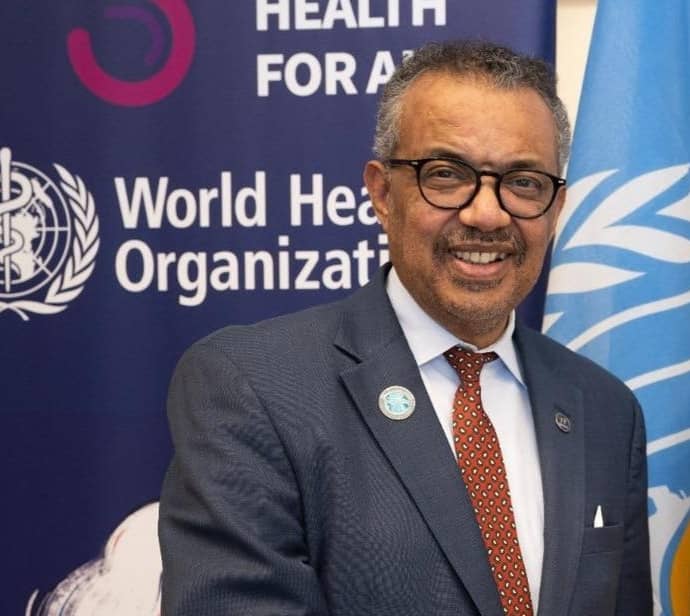


WHO Director-General Dr. Tedros Adhanom Ghebreyesus
By TNS News Team
GENEVA, Aug 15 – In a decisive move, the World Health Organization (WHO) has declared the ongoing mpox outbreak in the Democratic Republic of the Congo (DRC) and other African nations a Public Health Emergency of International Concern (PHEIC), raising alarms over the virus’s rapid spread and potential to spark another global crisis.
The declaration, made by WHO Director-General Dr. Tedros Adhanom Ghebreyesus, underscores the urgency of the situation as cases continue to surge across the Democratic Republic of the Congo (DRC) and spread into neighbouring countries.
This declaration follows the advice of an IHR Emergency Committee of independent experts who reviewed the situation and recommended urgent international action.
“The emergence of a new clade of mpox, its rapid spread in eastern DRC, and the reporting of cases in several neighbouring countries are very worrying,” Dr. Tedros stated.
“On top of outbreaks of other mpox clades in DRC and other countries in Africa, it’s clear that a coordinated international response is needed to stop these outbreaks and save lives.”
WHO Regional Director for Africa, Dr. Matshidiso Moeti, emphasized the ongoing efforts: “Significant efforts are already underway in close collaboration with communities and governments, with our country teams working on the frontlines to help reinforce measures to curb mpox. With the growing spread of the virus, we’re scaling up further through coordinated international action to support countries bring the outbreaks to an end.”
Committee Chair Professor Dimie Ogoina highlighted the global implications: “The current upsurge of mpox in parts of Africa, along with the spread of a new sexually transmissible strain of the monkeypox virus, is an emergency, not only for Africa, but for the entire globe.
Mpox, originating in Africa, was neglected there, and later caused a global outbreak in 2022. It is time to act decisively to prevent history from repeating itself.”
This PHEIC determination is the second in two years related to mpox. The disease, caused by an Orthopoxvirus, was first detected in humans in 1970 in the DRC and is considered endemic to central and west Africa.
The recent surge includes over 15,600 cases and 537 deaths this year alone, with a new strain, clade 1b, spreading primarily through sexual networks.
WHO is mobilizing resources, including an initial US$ 15 million, to support surveillance, preparedness, and response activities. The organization has also released US$ 1.45 million from its Contingency Fund for Emergencies and is appealing to donors for additional funding.
With coordinated international efforts and immediate action, WHO aims to curb the spread of mpox and prevent further outbreaks.
- TNS News